
Hyperbaric oxygen and brain injury: what we actually know.
If you are here because someone you love has a brain injury and you found a page promising that hyperbaric oxygen will fix it, please read this first. Some of what is being said about this treatment is supported. Some of it is ahead of the evidence. You deserve to know which is which.
- Joe’s role
- Named investigator, not an author
- Group
- USF HBOT for Veterans with TBI Collaborative Group
- Design
- Blinded randomized controlled trial with sham comparison
- Subjects
- 420
- Regulatory
- FDA IND/IDE #172640 · USF IRB #6819
- Protocol
- Trials 2026;27(1):352
Verified · PubMedRegistration →
Why Joe works on this
A twenty-eight-year career in hyperbaric systems, a doctorate in how pressure affects the body, a personal brain injury, and a trial built to answer the question.
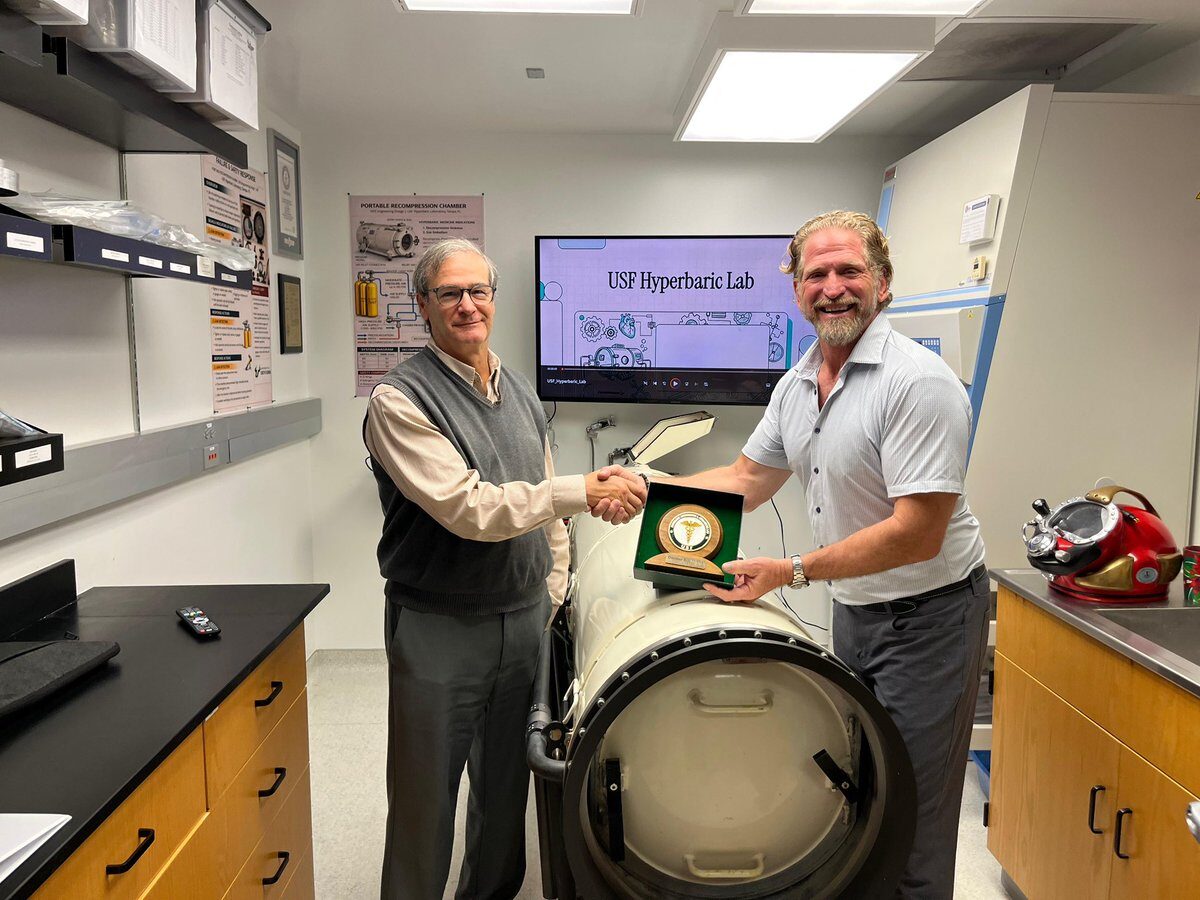
- Military career
- Commander, U.S. Navy (Retired). Twenty-eight years in hyperbaric systems, saturation diving, and life support for extreme environments. The systems that keep a diver alive at depth are the same physics that underpin hyperbaric medicine.
- Doctorate
- PhD in Biomedical Engineering, with research in hyperbaric and hypobaric medicine. Not a medical degree but a research degree, which is why the work on this page is science rather than clinical practice.
- University of South Florida
- Associate Professor of Practice. Assistant Vice President for Veterans Clinical Research. Named investigator on the USF hyperbaric oxygen trial for veterans with TBI (NCT06581003). Course director for a hyperbaric medicine training program.
- Personal stake
- Joe sustained a traumatic brain injury in a motor vehicle accident in 2021. The question of whether hyperbaric oxygen helps is not abstract to him.
- Project Neptune 100
- One hundred consecutive days living at ambient pressure underwater, 2023. Guinness World Record. The habitat held him at roughly 1.6 ATA, below the 2.0 ATA used in the USF trial and sustained around the clock rather than delivered in sessions. Preliminary single-subject results: cholesterol dropped 100 points, inflammatory markers fell by half, stem cell production increased, and sleep quality improved. One person is not a study, and formal analysis is ongoing.
- The textbook
- The Art and Science of Hyperbaric Medicine (2024). A textbook covering the field from physics to clinical application, co-authored with colleagues from the International Board of Undersea Medicine, where Joe serves as Chairman of the Board.
What the treatment does, biologically
A traumatic brain injury damages tissue. It also damages the blood supply to that tissue. Hyperbaric oxygen addresses the second problem and, by doing so, may create conditions for the first to heal.
In a hyperbaric chamber, a patient breathes pure oxygen at roughly twice normal atmospheric pressure. At that pressure, blood plasma carries far more dissolved oxygen than it does at sea level, enough to reach tissue that damaged blood vessels can no longer supply.
What researchers have observed in published studies:
Reduced inflammation. Brain injury triggers an inflammatory cascade that, after the acute phase, does more harm than good. Hyperbaric oxygen has been shown to reduce inflammatory markers, which may limit secondary damage to tissue that survived the initial injury.
New blood vessel formation. Injured brain tissue is oxygen-starved because the blood vessels feeding it are damaged. A 2017 study in Frontiers in Human Neuroscience demonstrated that HBOT can induce angiogenesis, the growth of new blood vessels, in brain-injured patients, restoring blood flow to tissue that had been cut off. Without blood flow, no repair process can reach the injury.
Neuroplasticity. The same study showed microstructural improvements in both white and gray matter, with measurable gains in memory, executive function, and processing speed, in patients an average of nearly seven years after their injury. That timeline matters: the conventional window for TBI recovery is much shorter, and the fact that change was observed years later suggests the brain retains more capacity for repair than previously assumed.
Stem cell mobilization. Hyperbaric oxygen has been associated with increased stem cell production, which may contribute to tissue repair. Joe’s own Neptune 100 data showed elevated stem cell markers after a hundred days of continuous pressure exposure.
What this does and does not mean. These mechanisms are real and published. The question is not whether these biological effects exist. It is whether they translate into meaningful recovery for a person with a brain injury, at what dose, how long after injury, and for which patients. That is exactly what the USF trial is designed to answer.
Boussi-Gross et al. demonstrated that HBOT induced angiogenesis and nerve fiber regeneration in TBI patients years after injury, with cognitive improvements exceeding 15%.
Frontiers in Human Neuroscience, 2017. PMID 29097988
The USF trial uses 2.0 atmospheres absolute (ATA) with 100% oxygen. The sham group receives normal air (21% oxygen) at 1.0 ATA. The difference matters. See the Q&A below on clinical vs. mild hyperbaric.
The trial that will settle it
A 420-subject randomized controlled trial at the University of South Florida, funded by the State of Florida, with FDA authorization. Actively enrolling.
Why this trial exists
Earlier studies of HBOT for TBI produced mixed results. Some showed benefit; some showed that the sham group improved too. The studies varied in pressure, number of sessions, timing after injury, and what they measured, which makes them difficult to compare and impossible to combine into a clear answer.
The Department of Defense’s Traumatic Brain Injury Center of Excellence reviewed the evidence as of 2025 and concluded that it does not yet support prescribing HBOT for TBI. Four of five DoD-funded randomized trials found no significant benefit over sham.
That is not the end of the question. It is the reason this trial was built. The USF study is designed to address the gaps those earlier trials left: it is larger (420 subjects vs. 50 to 72 in the DoD studies), it uses a rigorous sham comparison, it measures outcomes that matter to a person’s daily life, and it includes interim analyses so results do not wait until the last subject finishes.
How the trial works
- Design
- Blinded, adaptive, three-stage group sequential randomized controlled trial with sham comparison
- Treatment
- 40 sessions over 12 weeks. Each session approximately 60 minutes at 2.0 ATA with 100% oxygen. Sham arm receives air at 1.0 ATA
- Primary endpoint
- Neurobehavioral Symptom Inventory (NSI) score, a measure of the symptoms the patient actually lives with
- Secondary endpoints
- PTSD Checklist (PCL-5) scores. Number of dives needed for response
- Blinding
- Double-blind: participants, investigators, evaluators, and data analysts
- Interim analyses
- Planned after 84, 168, and 252 participants complete treatment
- Eligibility
- U.S. service members or veterans, age 18 to 75, with mild to moderate TBI at least one year post-injury
- Regulatory
- FDA IND/IDE #172640 · USF IRB #6819
- Funding
- State of Florida legislative appropriations, fiscal years 2022 to 2024
Protocol: Neumann D, Kumar A, Van Loveren H, et al. Trials 2026;27(1):352. PMID 41882764
One hundred days under pressure
In 2023, Joe lived underwater for a hundred consecutive days, at the same pressure used to treat brain injuries.
Project Neptune 100 placed Joe inside Jules’ Undersea Lodge in Key Largo, Florida, at a depth of 22 feet, for one hundred consecutive days. It set a Guinness World Record for the longest time living in an underwater fixed habitat. The record was the by-product. The question was what prolonged hyperbaric exposure does to the human body.
The depth held him at roughly 1.6 ATA, below the 2.0 ATA the USF trial uses, and sustained around the clock rather than delivered in forty separate sessions. That is a different exposure, not a smaller dose of the same one, and by the standard set out below, evidence for one does not transfer to the other.
What the preliminary data showed:
- Cholesterol dropped by 100 points
- Inflammatory markers fell by approximately 50 percent
- Stem cell production increased
- Collagen production increased
- REM sleep doubled
- Telomere length increased
These are preliminary, single-subject observations, not proof and not a clinical trial. One person is not a study. But the direction of every marker was consistent with the hypothesis that sustained pressure exposure may promote tissue repair, and the magnitude of change was large enough to justify formal investigation. That formal investigation is now the USF trial.
Single-subject data does not prove a treatment works. What it does is demonstrate feasibility and generate hypotheses worth testing in a real trial. Neptune 100 did both.
NBC News, PBS NewsHour, NPR, and Fox News covered the mission. The point is not that it was famous. The point is that every claim made about it was made in front of cameras, which is a form of accountability.
Straight answers
The questions people actually type, answered without hedging and without overselling.
Does hyperbaric oxygen therapy work for traumatic brain injury?
Still being determined, and anyone who tells you otherwise with total confidence is ahead of the evidence.
Several trials have reported that people report fewer symptoms after a course of hyperbaric oxygen. Several others found that people in the sham group improved too, which is exactly why sham groups exist. Trials have varied in pressure used, number of sessions, how long after injury treatment began, and what they measured, which makes them genuinely hard to compare.
Studies of moderate-to-severe TBI tend to show more positive findings than studies of mild TBI, but only a few such studies have been conducted since 2018. A 2017 study demonstrated structural brain changes and cognitive improvement in patients years after their injuries, which is the strongest evidence that something real is happening. But “something real” and “ready to prescribe” are different standards.
A 420-subject randomized controlled trial is running right now at the University of South Florida, built specifically to answer this with a proper sham comparison. Joe is a named investigator on it. It is registered as NCT06581003 and you can read the protocol yourself.
Protocol: Neumann D, Kumar A, Van Loveren H, et al. Trials 2026;27(1):352. PMID 41882764
What does the Department of Defense say about HBOT for TBI?
As of 2025, the DoD does not recommend HBOT for TBI. That is an honest assessment of the evidence available to them, and it is important that you know it.
The DoD’s Traumatic Brain Injury Center of Excellence reviewed the literature and concluded that available evidence does not yet support prescribing HBOT for TBI or post-concussion symptoms. Four of five military-funded randomized trials found no significant difference between treatment and sham groups. The fifth showed positive results but lacked a sham control.
This is not a reason to stop investigating. It is a reason the USF trial exists. The earlier military studies were small (50 to 72 subjects each). The USF trial enrolls 420 subjects, uses a rigorous double-blind sham comparison, and includes three interim analyses. If hyperbaric oxygen helps, this study is large enough to show it. If it does not, that is worth knowing too.
Is hyperbaric oxygen safe?
Hyperbaric oxygen is well characterized, and in a properly maintained chamber run by trained people the risks are known and generally manageable. The recognized ones: middle-ear barotrauma, which is common and usually minor; sinus and dental barotrauma; temporary vision changes; and rarely, an oxygen-induced seizure.
Risk is not zero, and it is not the same everywhere. A chamber’s condition and its operators’ training matter enormously, which is the part of this field Joe spends most of his professional time on, as course director for USF’s hyperbaric medicine training program and Chairman of the International Board of Undersea Medicine.
Whether it is safe for you is a question for the physician overseeing your treatment.
What is the difference between clinical HBOT and “mild” hyperbaric therapy?
Pressure and oxygen concentration, and the difference is not a detail.
Clinical hyperbaric oxygen therapy generally means near-100% oxygen at roughly 2.0 to 2.4 atmospheres absolute, in a chamber rated and maintained for that pressure. The USF trial uses 2.0 ATA.
“Mild” hyperbaric therapy usually means a soft-sided chamber at around 1.3 atmospheres, often with concentrated air rather than pure oxygen.
These are different exposures. Evidence for one does not transfer to the other. When you read a claim, find out which one is being described. A great many confident statements online quietly swap the two.
How long does a course of treatment take?
The USF trial protocol specifies 40 sessions over approximately 12 weeks, delivered Monday through Friday. Each session is approximately 60 minutes of exposure at pressure, with additional time for pressurization and depressurization, roughly 75 to 90 minutes door-to-door.
Whether this is the optimal protocol is part of what the trial is investigating. The secondary endpoint of “number of dives needed for response” is designed to help determine whether some patients benefit from fewer sessions than others.
How do I read a study and decide whether to believe it?
This is the question I most want you to be able to answer without me. Five things to ask:
- Was there a control group, and was it a real sham?
- How many people? Twelve is a hint. Four hundred is evidence.
- Who measured the result, and did they know which group the patient was in?
- Did they measure something that matters to a person’s life, or a number on a lab report?
- Was this the outcome they said they’d measure before they started?
Can I enroll in the USF trial?
The trial is actively enrolling. Eligibility: U.S. service members or veterans, age 18 to 75, with a history of mild to moderate TBI at least one year post-injury, who are experiencing chronic TBI symptoms and can tolerate lying in a chamber for one hour.
Contact the study team directly:
- Email: MCOM-hbotstudy@usf.edu
- Phone: 813-396-9200
- Registration: ClinicalTrials.gov →
- Study site: hbot.usf.edu →
You served. This research is for you.
The USF trial was built for veterans and service members with traumatic brain injuries. The brain injury book is free to any veteran who asks for it: active duty, National Guard, reserve, retired. No purchase and no obligation.
